
BPC-157: What Research Shows (and What It Doesn’t)
The “Body Protection Compound” Phenomenon: BPC-157
We are entering an era of ‘precision recovery,’ where we no longer have to wait for the body to heal on its own schedule. At the forefront of this shift is BPC-157. While the internet is flooded with anecdotes about this ‘Body Protection Compound,’ cutting through the noise requires looking at the actual cellular mechanics and how it is used. BPC-157 isn’t just another supplement; it’s a specific sequence of amino acids that tells your body exactly where and how to begin the rebuilding process.
At Meeting Point Health, we focus on therapies that align with the body’s natural repair mechanisms, informed by robust science and clinical experience. While BPC-157’s popularity stems from compelling preclinical research and growing practitioner observations, we emphasize informed, supervised use to maximize benefits and safety.
Here, we provide an objective overview and more of:
- What is BPC-157?
- How does BPC-157 work?
- Is BPC-157 completely safe?
- Is BPC-157 only for athletes?
- Do you have to inject BPC-157 for it to work?
- Will a higher dose give you better results?
What is BPC-157?
BPC-157 is a short chain of amino acids originally identified in gastric juices, often described as a “body repair signal” that helps coordinate the protection and renewal of tissues throughout the gut and beyond. In integrative medicine, it’s viewed as a targeted peptide messenger that may support the body’s own healing responses, especially in the digestive tract, joints, and soft tissues.
The Science: How Does BPC-157 Work?
Rather than overriding natural processes like many pharmaceuticals, BPC-157 acts as a cytoprotective mediator, coordinating repair through targeted pathways:
- Angiogenesis (Vascular Recruitment): One of its most potent effects is the promotion of “collateralization,” the creation of new blood vessels. By bypassing damaged vessels to create new pathways for blood flow, BPC-157 ensures that oxygen and nutrients can actually reach the site of an injury.
- The Nitric Oxide (NO) Toggle: BPC-157 modulates the nitric oxide system. It helps balance NO levels to protect the endothelial lining of blood vessels, ensuring they remain flexible and resilient rather than inflamed.
- Fibroblast Activation: For those looking at tendon or ligament health, this is a significant mechanism. BPC-157 upregulates growth hormone receptors on fibroblasts (the cells that produce collagen). This makes the body’s natural growth signals more effective, speeding up the structural rebuilding of dense connective tissues.
- Strengthening the “Gates”: It enhances the expression of tight-junction proteins. These are the “glue” that keeps the gut lining and vascular barriers intact, which is why it is often cited in discussions regarding “leaky gut” and systemic inflammation.
These mechanisms contribute to its broad regenerative effects observed in animal models across musculoskeletal, gastrointestinal, and systemic systems.
What is BPC-157 Used For?
BPC-157 supports collagen and reticulin formation and is anti-inflammatory. Common clinical goals for BPC-157 include:
- Supporting soft-tissue healing (tendons, ligaments, muscles, and fascia) after injury or overuse
- Promoting post-surgical recovery and tissue regeneration
- Reducing inflammation and associated pain in joints and musculoskeletal conditions
- Supporting gut lining integrity and symptoms related to gastric ulcers, IBS, or “leaky gut”
- Assisting recovery from sports-related injuries and enhancing exercise recovery
- Supporting blood flow to injured tissues to aid repair
- Adjunctive support for chronic pain related to tissue or nerve injury
Addressing Common Misconceptions and Questions Surrounding BPC-157
Online discussions often include myths that can cloud understanding. Here’s a clear look at some of the most commonly asked questions regarding BPC-157 and its use:
“Is BPC-157 completely safe, because it’s natural?”
No. Natural origin doesn’t automatically mean safe, and BPC‑157 is not a vitamin or herbal supplement; it’s a laboratory-made peptide that is still being studied. Early animal and small human studies suggest it is generally well tolerated in the short term, but we do not yet have large, long‑term trials.
There is a significant difference between the trace amounts of BPC-157 naturally produced in your stomach and the concentrated, systemic doses used for therapeutic repair. At these higher levels, the peptide exerts potent biological signals that bypass the body’s usual feedback loops. For these reasons, professional oversight is necessary to navigate the lack of standardized human dosing and to ensure the purity of the source.
“Is BPC-157 only for athletes and bodybuilders?”
The most compelling applications extend far beyond performance enhancement. Preclinical data and clinical observations point to potential in chronic inflammatory conditions (like IBD), persistent joint injuries, and even neuroprotective support. It is a tool for quality-of-life restoration, not just for athletic or bodybuilding performance.
“Are all sources of BPC-157 the same?”
No. Quality varies dramatically. In late 2023, the FDA moved BPC-157 to “Category 2,” citing concerns over impurities and immunogenicity in unregulated batches. “Research-only” versions found online often lack the third-party testing required for human safety, and sites have been found to lie about being third-party tested as well. Clinical-grade BPC-157 from verified compounding pharmacies minimizes risks of impurities, incorrect sequences, or contaminants that could trigger immune responses. They are third-party tested for purity.
“Are injections the only effective route for BPC-157?”
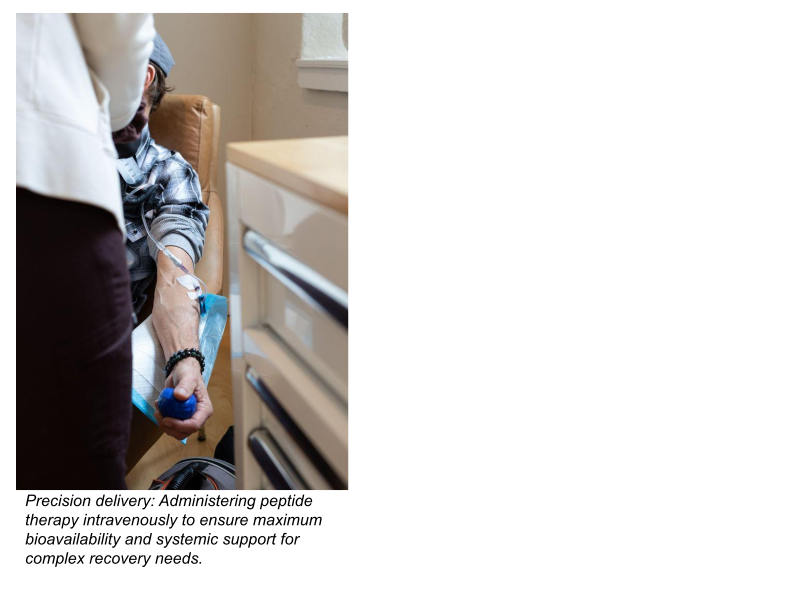
This is not always the case. Some peptides can also be taken orally, such as in a lozenge, spray, or capsule, which can be the most convenient option for something like intestinal or gut health benefits with BPC-157. However, optimal success is associated with intravenous or subcutaneous injection, because these delivery methods have a high bioavailability; this is often cited as 80-95% or near-complete systemic delivery, because it bypasses degradation and enters the bloodstream directly.
Overall, proper oral administration may support systemic and gut-specific repair effectively, while localized injections or intravenous therapy is more suitable for targeted musculoskeletal issues.
“Will a higher dose of BPC-157 give me better results?”
In the “more is better” culture of fitness and biohacking, it’s easy to assume doubling the dose doubles the recovery speed. However, BPC-157 doesn’t work like a fuel you burn; it works like a biological signal.
The Receptor Ceiling: BPC-157 functions by binding to specific receptors on your cells. Once those receptors are fully occupied, adding more of the peptide is like shouting at someone who is already following your instructions. It doesn’t make them work faster; it just creates extra noise.
“How long does BPC-157 stay in your system?”
BPC-157 appears to have a relatively short half-life in the body, meaning the peptide itself does not linger in the bloodstream for very long after each dose. However, the physiological effects (such as changes in inflammation or tissue healing signals) may last longer than the measurable presence of the peptide.
Because high-quality human data are limited, there is no universally accepted “clearance time,” so we emphasize individualized dosing, careful monitoring, and regular re-evaluation rather than assuming it is quickly or completely out of the system after a set number of days.
“Once I start BPC-157, will I need to take it forever to maintain results?”
Not necessarily. BPC-157 is often used as a bridge to healing, not a permanent crutch. Typical protocols involve a series of weeks on the peptide, followed by a rest period where the peptide isn’t administered. It is important to see how your body is responding to the treatment during these rest periods where your baseline can be further assessed. For long-term use, it is especially important to have medical oversight and guidance.
While BPC-157 shows no strong evidence of tolerance or receptor desensitization in most reports (unlike some growth hormone-releasing peptides), cycling is still utilized for safety, sustainability, and optimization.
The Bottom Line: A Promising Tool in Regenerative Care
Extensive animal research highlights BPC-157’s multi-system healing potential, unmatched by many compounds. Emerging human data, including small pilot studies showing good tolerability (e.g., intravenous infusions up to 20 mg with no adverse effects) and subjective improvements in conditions like chronic knee pain, further support its promise. Large-scale, randomized trials remain limited, largely due to funding priorities favoring patentable therapies over peptides like this.
At Meeting Point Health, we view BPC-157 not as a standalone “cure-all,” but as a sophisticated biological signal best used when:
- Sourced from reputable, verified pharmacies.
- Dosed and monitored based on your individual markers and needs.
- Combined with other functional and regenerative medicine protocols to provide the necessary support for repair.
Ready to Explore Further?
Healing is deeply individual, and there is no single approach that works for everyone. If you’re curious about BPC-157 or other regenerative therapies, the best next step is a personalized clinical evaluation to determine whether your unique biology is a good fit for our treatment protocols.
Schedule a Consultation at Meeting Point Health
References
- Lee, E., & Burgess, K. (2025). Safety of Intravenous Infusion of BPC157 in Humans: A Pilot Study. Alternative therapies in health and medicine, 31(5), 20–24.
- Sikiric, P., Seiwerth, S., Skrtic, A., Staresinic, M., Strbe, S., Vuksic, A., Sikiric, S., Bekic, D., Soldo, D., Grizelj, B., Novosel, L., Beketic Oreskovic, L., Oreskovic, I., Stupnisek, M., Boban Blagaic, A., & Dobric, I. (2025). Stable Gastric Pentadecapeptide BPC 157 as a Therapy and Safety Key: A Special Beneficial Pleiotropic Effect Controlling and Modulating Angiogenesis and the NO-System. Pharmaceuticals, 18(6), 928. https://doi.org/10.3390/ph18060928
Written by Amanda Bates, RN and medically reviewed by Dr. Stephen Matta.


